
TOEIC Part 5 (Incomplete Sentences): the grammar that keeps appearing
IELTS specialists — MUIC & Chulalongkorn University alumni, IELTS Speaking Band 9, trained via IDP IELTS teacher courses.
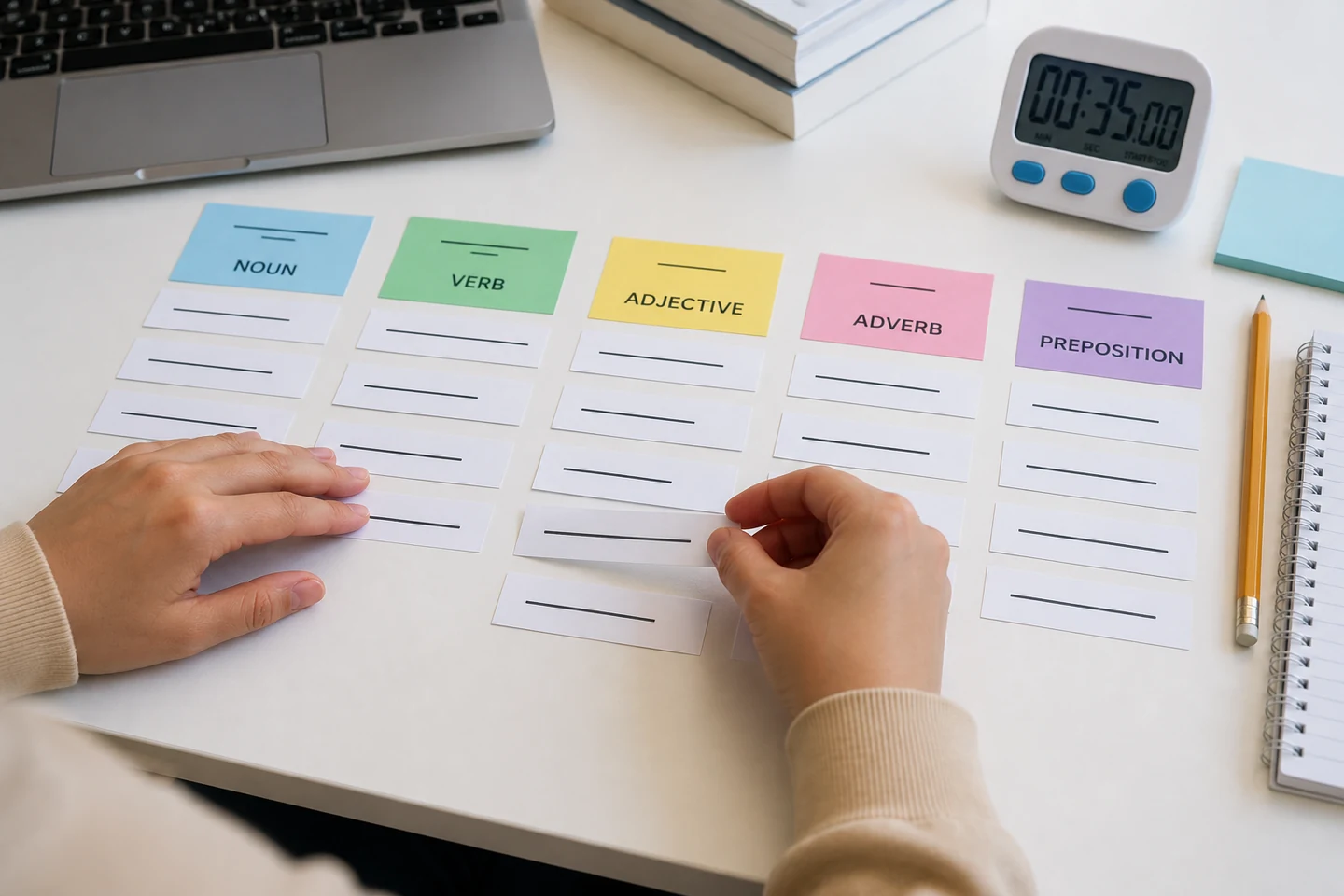
TOEIC Part 5 gives you a sentence with a gap and four options, testing grammar and vocabulary. Most items fall into a few repeating types: word form (part of speech), prepositions, verb tense and subject–verb agreement, and conjunctions vs prepositions. The fast method is to look at the words around the gap first — the grammar usually tells you the answer before meaning does.
Word form — read the slot, not the meaning
Often the four options are forms of one word (succeed, success, successful, successfully). Decide what part of speech the slot needs: an adjective before a noun, an adverb to modify a verb, a noun after 'the'.
- The project was a complete ______. → noun (success).
- The team worked ______ to meet the deadline. → adverb (successfully).

Prepositions and set phrases
Many items test fixed combinations: interested in, responsible for, depend on, in charge of, by + time. Learn these as chunks so you recognise them instantly rather than reasoning them out.
Tense and agreement
- Time markers signal tense: 'since 2020' → present perfect; 'yesterday' → past; 'next week' → future.
- Match the verb to the real subject: 'The list of items ______' takes a singular verb (the subject is 'list').
Conjunctions vs prepositions
'Because' is followed by a clause (subject + verb); 'because of' by a noun. The same trap appears with although/despite and while/during. Check whether a full clause or just a noun follows the gap.
A fast decision method
- Read only around the gap first; the local grammar usually decides it.
- If the options are one word in four forms, it's a word-form item — pick by part of speech.
- If two options mean the same, the answer is usually neither — look for a grammar difference.
- Never leave it blank; eliminate and guess if unsure.
Frequently asked questions
How much time per Part 5 question?
Aim for about 20–30 seconds each. Part 5 is where you save time to spend on the longer Part 7 passages.
Is Part 5 grammar or vocabulary?
Both. Many items are pure grammar (form, tense, agreement); others test which word fits the meaning and collocation.
Do I need to understand the whole sentence?
Not always. Word-form and preposition items can be answered from the words next to the gap, which saves time.
Turn the guide into a concrete study plan with free practice, mock tasks and instant feedback.
Trusted by 3,000+ students nationwide · free to start, no card needed