English Requirements for International Universities: the IELTS scores you need
IELTS specialists — MUIC & Chulalongkorn University alumni, IELTS Speaking Band 9, trained via IDP IELTS teacher courses.

Almost every international university asks for proof of English, and IELTS Academic is the score they accept most widely. As a rough guide, many undergraduate courses want an overall IELTS band of about 6.0–6.5; competitive courses, UK Russell Group universities and most postgraduate programmes often ask for 6.5–7.0; and a few demanding subjects (such as medicine, law or teaching) can require 7.0–7.5 — usually with a per-skill minimum, for example no band below 6.0 or 6.5. These numbers are typical and change by course, so always confirm the exact requirement on each university's official admissions page.
The short answer: typical IELTS bands by course level
There is no single number. What a university asks for depends on the country, the course and how competitive it is — but the ranges below cover most cases and give you a realistic target to aim at.
Treat every figure here as typical and approximate. Requirements change from year to year and differ between courses at the same university, so the band that matters is the one printed on your specific course page — always confirm it there.
- Standard undergraduate courses: often an overall IELTS band of about 6.0–6.5.
- Competitive courses, UK Russell Group universities and most taught master's degrees: commonly 6.5–7.0.
- High-demand subjects such as medicine, dentistry, law, nursing and teaching, plus some top programmes: frequently 7.0–7.5, usually with a per-skill minimum.
- Foundation and pathway programmes: sometimes accept a lower band (around 5.0–5.5) because English support is built in.

Which test is accepted — IELTS vs TOEFL vs Duolingo
Most universities accept more than one English test, but they are not interchangeable, and the score bands are not identical across tests. Check which tests your target course lists — and the score it wants on each — before you book anything.
As a rough cross-check only, IELTS 6.5 is often treated as roughly TOEFL iBT 79–93, and IELTS 7.0 as roughly 94–101. Each university publishes its own equivalency table, so always use theirs rather than a general conversion.
- IELTS Academic — the most widely accepted test for university admission worldwide, and the safest default for the UK, Australia, Canada and much of Europe.
- TOEFL iBT — broadly accepted too, and especially common at universities in the United States.
- Duolingo English Test (DET) — now accepted by many universities and convenient to sit from home, but not accepted everywhere, so confirm before relying on it.
- PTE Academic — accepted by many institutions as well; again, check the course page.
Typical requirements by destination (UK / US / Australia / Canada)
Requirements cluster by country, though they always vary by course. Use this as a starting picture, then confirm the exact band on the official admissions page.
- United Kingdom — undergraduate often 6.0–6.5 overall; Russell Group and competitive courses 6.5–7.0; some professional subjects 7.0–7.5, typically with a per-skill floor. Certain visa or foundation routes require a UKVI (SELT) version of IELTS, so check which one you need.
- United States — many universities accept IELTS or TOEFL; undergraduate entry is often around IELTS 6.5 (roughly TOEFL 79–90), while selective universities ask for 7.0+ (TOEFL 100+).
- Australia — undergraduate commonly 6.0–6.5 overall, frequently with no band below 6.0; postgraduate and professional courses are higher. Student-visa English rules can apply on top of the university's own requirement.
- Canada — undergraduate commonly 6.0–6.5 overall; competitive and postgraduate programmes often 6.5–7.0.
Undergraduate vs postgraduate: what changes
As a rule, the higher the level and the more competitive the course, the higher the English bar — and the more likely it is to specify a minimum in each skill rather than just an overall number.
Taught master's degrees commonly ask for 6.5–7.0, often with a Writing minimum because so much of the assessment is written. Research degrees and professional programmes such as law, medicine and teaching can go higher still. Undergraduate entry is usually a little lower, but the same per-skill logic applies.
Per-skill minimums and score validity — the details people miss
Two details trip up otherwise strong applicants. First, the per-skill minimum: many courses set a floor for each of the four skills (for example, no band below 6.0 or 6.5) on top of the overall requirement. A 7.0 overall with a 5.5 in Writing can still be rejected — you must clear both the overall band and every minimum.
Second, validity: IELTS results are generally valid for two years from the test date. Time your test so the score is still valid when you actually enrol, not just when you apply.
Do international-school students still need IELTS?
Often, yes. Studying in English at an international school does not automatically exempt you from an English test. Some universities do grant exemptions — for example, for a recognised English-medium diploma, or for a set number of years of study in English in a country on their approved list — but the policy is set by each university, and many still require IELTS or TOEFL unless you meet a specific, published exemption.
So the safe assumption for most international-school students is that they will need to take IELTS. Check the exemption rules for each university on your list individually, and if you are not certain you qualify, prepare for the test anyway — it keeps every option open and is often needed for the student visa as well.
How to prepare and hit your band
The score is very trainable. The fastest route is the same one examiners' own advice points to: find your weakest skill, give it most of your time, practise under real exam timing, and get specific, per-criterion feedback on the productive skills — Writing and Speaking — rather than simply doing more questions.
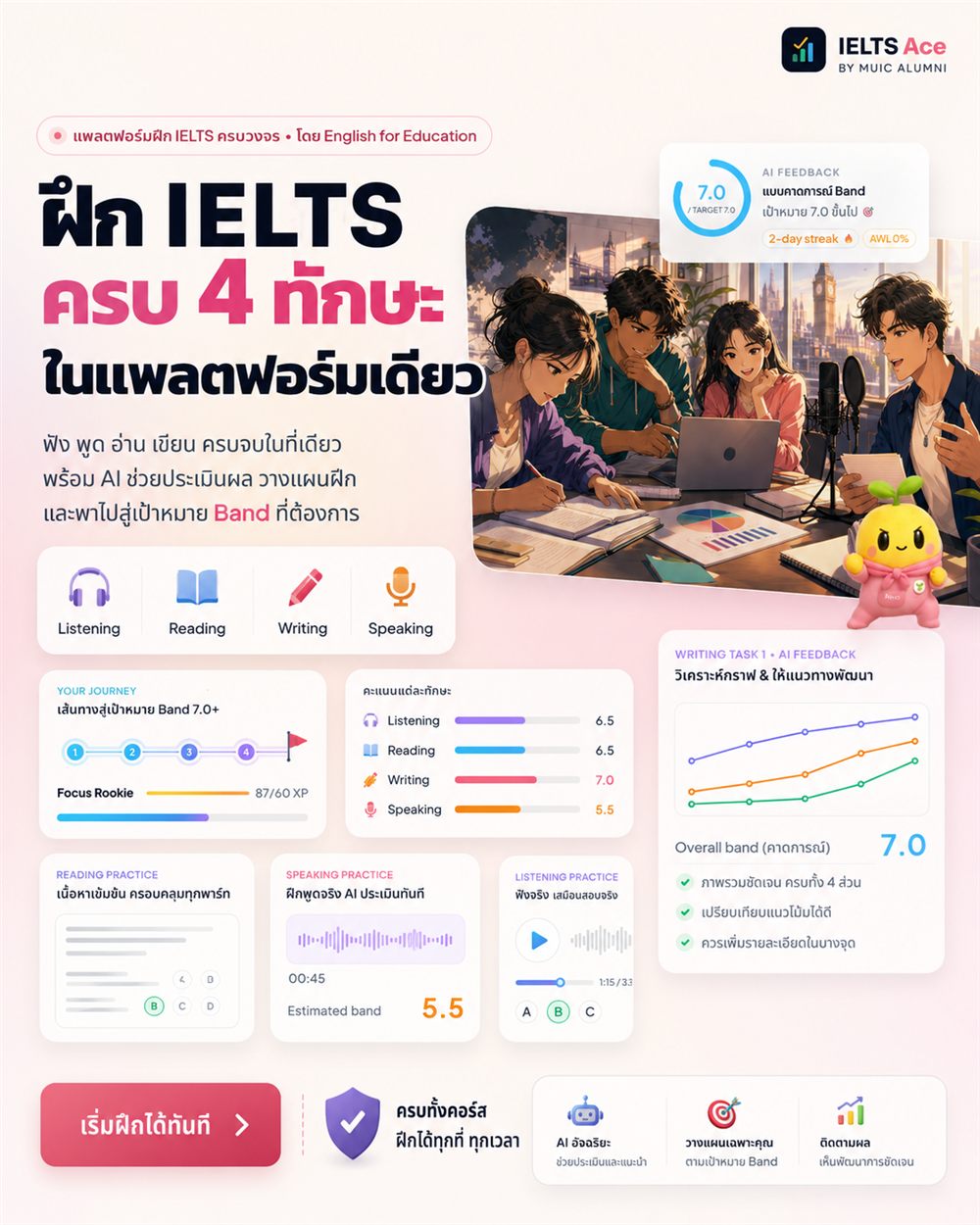
This is exactly what engforedu.com is built for. It offers bilingual (Thai and English) IELTS practice with AI band scoring on Writing and Speaking against the official criteria, full timed mock tests, and a personalised study plan that targets the band your university asks for. The honest part: it is a practical way to close the gap, not a shortcut — most learners already near 6.5 still need about 8–12 weeks of consistent, feedback-driven practice to reach a 7.
Start with a diagnostic. Knowing your current band in each skill turns a vague goal (get IELTS for university) into a concrete plan — how far each skill has to move, and how long that will realistically take before your application deadline.
Common mistakes to avoid
- Assuming an international-school background means no IELTS is needed — check each university's exemption policy first.
- Looking only at the overall band and missing a per-skill minimum you don't yet meet.
- Preparing for the wrong test — for example, relying on the Duolingo English Test where the course only accepts IELTS or TOEFL.
- Booking the real exam before a full timed mock shows your scores hold at target.
- Leaving it too late — bands take weeks to move, and results must still be valid when you enrol.
- Trusting an old or second-hand requirement; cutoffs change year to year, so read the current course page.
How to meet the English requirement for your university
- 1Find the exact requirement
On the university's official course page, note the overall band it asks for and any minimum in each skill — not a general figure from a forum.
- 2Take a diagnostic
Sit a timed IELTS diagnostic to see your current band in Listening, Reading, Writing and Speaking.
- 3Set a target and plan backwards
Count back from your application or visa deadline and build a weekly plan with the band you need as the target.
- 4Fix your weakest skill first
Give most of your time to the skill furthest below target, since one low skill can miss a per-skill minimum.
- 5Practise under exam timing
Use real time limits and word counts so your practice scores actually mean something.
- 6Get per-criterion feedback
Have every Writing and Speaking attempt scored against the four official criteria, then fix and re-score.
- 7Book when a mock confirms readiness
Sit a full timed mock and book the real test only when your scores hold at or above target — overall and in every skill.
Frequently asked questions
What IELTS score do I need for university abroad?
Typically about 6.0–6.5 overall for many undergraduate courses, 6.5–7.0 for competitive or Russell Group courses and most postgraduate programmes, and 7.0–7.5 for demanding subjects — often with a per-skill minimum. Always confirm the exact number on the university's official page.
Do international-school graduates need IELTS?
Often yes. An English-medium education doesn't automatically exempt you; some universities grant exemptions for recognised qualifications, but many still require IELTS or TOEFL unless you meet a specific published exemption, so most students should plan to take it.
IELTS or TOEFL for university?
Both are widely accepted. IELTS Academic is the most widely accepted worldwide, and TOEFL iBT is especially common in the US. Choose the one your target universities accept, and prepare for that exact format.
Is the Duolingo English Test accepted by universities?
Many universities now accept the DET, but not all, and some only for certain courses. Check each university's accepted-test list before relying on it.
How long does it take to prepare for IELTS 7?
Most learners already near 6.5 need about 8–12 weeks of consistent, feedback-driven practice to reach a 7. Larger jumps from a lower starting band take longer.
How long are IELTS results valid?
Usually two years from the test date. Time your test so the score is still valid when you enrol, not only when you apply.
What is a per-skill minimum?
Beyond the overall band, many courses set a floor for each skill (for example, no band below 6.0 or 6.5). You must meet both the overall requirement and every individual minimum.
Turn the guide into a concrete study plan with free practice, mock tasks and instant feedback.
Trusted by 3,000+ students nationwide · free to start, no card needed