Taking the GED in Thailand (2026): how to register, cost per subject, test rules and using it for Thai universities
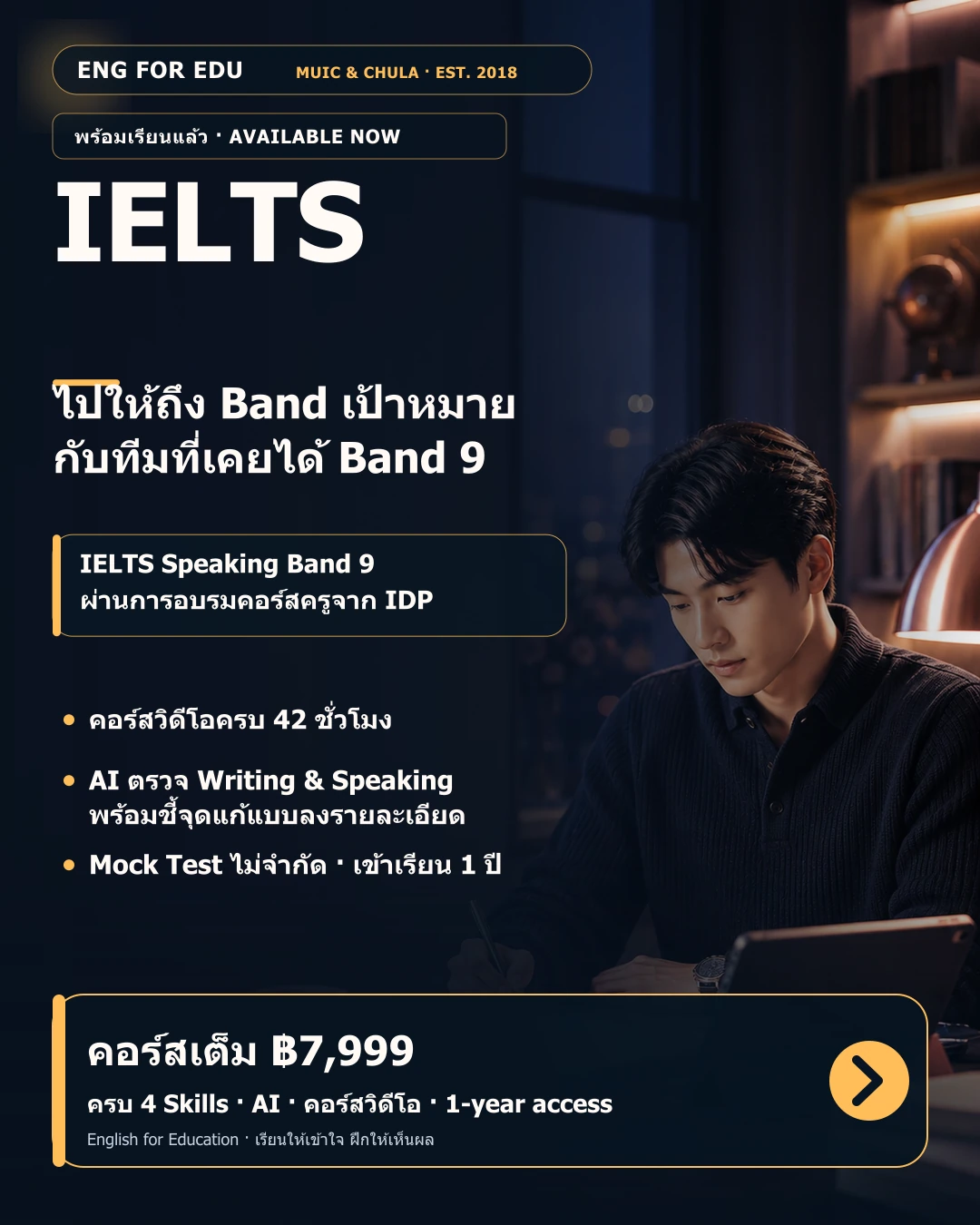
IELTS specialists — MUIC & Chulalongkorn University alumni, IELTS Speaking Band 9, trained via IDP IELTS teacher courses.
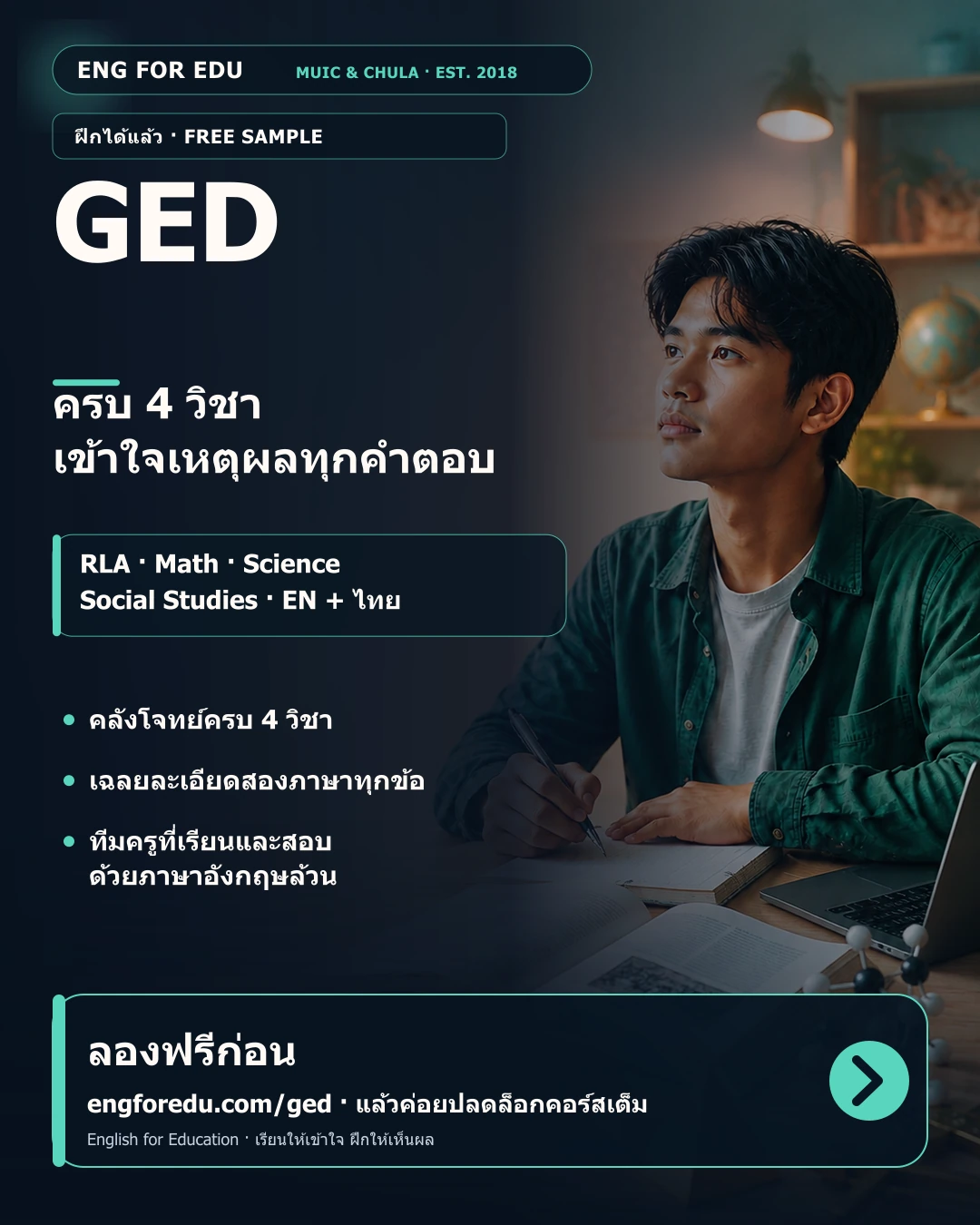
To take the GED in Thailand, create an account on GED.com, score at least 145 on the official GED Ready practice test, then book each subject at a test centre through GED.com — GED.com's Thailand page lists the price as US$90 per subject (US$360 for all four) and the test is in English only. Each of the four subjects (Reasoning Through Language Arts, Mathematical Reasoning, Science and Social Studies) is scored 100–200: 145 passes, 165–174 is GED College Ready and 175–200 is College Ready + Credit. To use the GED for Thai university admission you request an equivalency certificate through Chulalongkorn University's HSCES system for TCAS and meet each programme's own minimum — MUIC, for example, asks for a total of at least 600 with at least 145 in every subject — and because requirements change, confirm with the institution.
What do you need to take the GED in Thailand?
GED.com has a policy page for Thailand that applies to everyone testing here, Thai or foreign. You do not need documents proving residency, the test is offered only in English, and the credential you earn is the District of Columbia High School Equivalency Diploma — GED Testing Service's international credential. After you pass, you automatically receive one free electronic diploma and one free electronic transcript.
- Age: at 18 or older you can test with no restriction. At 16 or 17 you cannot book a test until you have completed an Age Waiver.
- ID: a valid passport (Thai or foreign), a valid Thai citizen ID card, or a Thai pink ID card for non-citizens — showing your full name, date of birth and photo.
- GED Ready: you must score at least 145 on the official GED Ready practice test before GED.com lets you schedule the GED test.
- Language: English only.

How much does the GED cost in Thailand?
GED.com's Thailand page says the GED currently costs US$90 per subject. You pay in US dollars when you book on GED.com, so the baht amount depends on your card's exchange rate. Because you book and pay subject by subject, you can spread the cost over several months. GED Ready, the official practice test, is bought separately on GED.com — check its price in your account.
| Subjects booked | Fee |
|---|---|
| One subject | US$90 |
| Two subjects | US$180 |
| All four subjects | US$360 |
How do you register for the GED in Thailand, step by step?
- Create a free account on GED.com with your details and Thailand as the country where you will test.
- If you are 16 or 17, complete the Age Waiver in your account first — you cannot book until it is done.
- Study, then take GED Ready. You need at least 145 before GED.com lets you schedule the real test.
- Book a subject in GED.com: choose the test centre, date and time, then pay US$90. You can take subjects one at a time, or all four on one day if a centre's hours allow it.
- On test day bring the ID you registered with — passport, Thai ID card or pink card.
- Your scores are posted to your GED.com account. Pass all four subjects (145+ in each) to receive your free electronic diploma and transcript.
Where can you take the GED in Thailand — at a test centre or online?
In Thailand you take the GED on a computer at a test centre. You choose the centre and time inside GED.com when you book — Pearson VUE's own GED page sends test-takers to GED.com — so the GED.com scheduler is the official place to see which centres currently offer the GED in Thailand. We do not list centre names or addresses here, because that list lives in the scheduler and changes.
Online testing: GED.com's Thailand page describes testing at a test centre and offers no online option for Thailand. GED Testing Service launched its online proctored GED for select U.S. states and territories and said it was not available internationally. If that ever changes, the options shown in your GED.com account are the ones that count.
What are the four GED subjects and how long is each test?
You schedule each subject separately and can take them in any order. Mathematical Reasoning, Science and Social Studies provide an on-screen calculator.
| Subject | Test time | What it covers |
|---|---|---|
| Reasoning Through Language Arts | 150 minutes, including a 10-minute break and 45 minutes for the essay | Reading for meaning, identifying and creating arguments, grammar and language |
| Mathematical Reasoning | 115 minutes, including a 3-minute break | Basic math, geometry, basic algebra, graphs and functions |
| Science | 90 minutes | Reading for meaning in science, designing and interpreting experiments, using numbers and graphics |
| Social Studies | 70 minutes | Reading for meaning in social studies, analysing historical events and arguments, using numbers and graphs |
What GED score do you need — 145, 165 or 175?
Each subject is scored from 100 to 200. You need at least 145 in every subject — not as an average — to earn the GED credential. The higher levels show college readiness and matter mostly at U.S. colleges.
| Score | Level | What it means |
|---|---|---|
| 100–144 | Below passing | Retake the subject |
| 145–164 | GED passing score | Counts towards the credential — you need 145+ in all four subjects |
| 165–174 | GED College Ready | Ready for college-level courses; may qualify for placement-test waivers |
| 175–200 | GED College Ready + Credit | May qualify for up to 10 college credit hours |
Can you retake a GED subject?
Yes. GED.com's Thailand page says that after taking a subject three times you must wait 60 days before testing in that subject again. Each attempt is a new booking, so read your score report and fix your weakest skills before you rebook.
Is the GED accepted by Thai universities?
In TCAS the GED is handled like other foreign high-school qualifications, so you prove equivalence before you apply. Chulalongkorn University's Academic Testing Center runs the High School Certificate Equivalency System (HSCES) for students who studied abroad or use the GED: if you have passed all GED subjects you request a High School Equivalence Certificate; if you have not finished all subjects yet you request a Provisional Equivalence Certificate; and a GPAX Equivalence Certificate converts your results to the Thai 4.0 grade scale.
Each programme then sets its own rule. Mahidol University International College (MUIC), for example, lists the GED among accepted qualifications for its 2026–2027 regular admission with a total score of at least 600, at least 145 in each subject, and your most recent educational record. Requirements change — confirm with the institution before you test or apply.
How should Thai students prepare for the GED?
Start with a free diagnostic and daily practice at engforedu.com/journey, then drill GED-style questions with English–Thai explanations at engforedu.com/ged/practice. Take GED Ready only when your practice scores are steady, because it is the gate to booking.
Three of the four subjects are reading-heavy, so the English reading load matters as much as content knowledge: read short academic texts every day, practise the 45-minute essay for Reasoning Through Language Arts, and learn to read charts and data for Science and Social Studies.
How to register for the GED in Thailand
- 1Create a GED.com account
Sign up on GED.com with your details and Thailand as your testing country.
- 2Complete the Age Waiver if needed
Test-takers aged 16 or 17 must finish the Age Waiver before they can book.
- 3Pass GED Ready
Score at least 145 on the official GED Ready practice test to unlock scheduling.
- 4Book and pay
Choose a subject, test centre and time in GED.com and pay US$90 per subject.
- 5Bring valid ID
Bring your passport, Thai ID card or pink ID card on test day.
Frequently asked questions
How much does the GED cost in Thailand?
US$90 per subject, or US$360 for all four, according to GED.com's Thailand page. You pay in US dollars when you book, so the baht amount depends on your card's exchange rate.
Can I take the GED online in Thailand?
Not according to GED.com's Thailand page, which describes testing at a test centre. GED Testing Service's online proctored test was launched for select U.S. states and territories and was not available internationally — check the options in your GED.com account.
How old do I have to be to take the GED in Thailand?
18 or older to test without restriction. If you are 16 or 17 you must complete an Age Waiver on GED.com before you can book.
What is the passing score for the GED?
145 in each of the four subjects, on a 100–200 scale. 165–174 is GED College Ready and 175–200 is GED College Ready + Credit.
Can I use the GED to apply to Thai universities?
Yes, through an equivalency route: for TCAS you request a certificate from Chulalongkorn University's HSCES system, and each programme sets its own minimum — MUIC asks for a total of at least 600 with at least 145 per subject for 2026–2027. Requirements change — confirm with the institution.
Do I have to take all four GED subjects on the same day?
No. You book subjects separately. GED.com says you can take all four on one day only if you find a test centre with hours that allow it.
Official sources
Verify current formats, scores and rules with the organisations that publish them.
- GED.com — GED testing policies for Thailand: US$90 per subject, GED Ready 145 before scheduling, ID, age waiver, retakes and the credential ↗
- GED.com — GED test subjects: what each of the four tests covers and how long it takes ↗
- GED.com — GED test scores: 145 to pass, 165–174 College Ready, 175–200 College Ready + Credit ↗
- GED Testing Service — Introducing the official online GED test (select U.S. states and territories; not available internationally) ↗
- Chulalongkorn University Academic Testing Center — High School Certificate Equivalency System (HSCES) for foreign qualifications and GED ↗
- Mahidol University International College (MUIC) — Regular applicants AY2026–2027: GED total of at least 600 with at least 145 in each subject ↗
Turn the guide into a concrete study plan with free practice, mock tasks and instant feedback.
Trusted by 3,000+ students nationwide · free to start, no card needed
Keep reading