
Business English emails: phrases you can copy (openings to sign-offs)
IELTS specialists — MUIC & Chulalongkorn University alumni, IELTS Speaking Band 9, trained via IDP IELTS teacher courses.

A clear business email has five parts: a specific subject line, a greeting, a one-line purpose, the details, and a call to action with a sign-off. Keep it short, one topic per email, and stay polite by using softer phrasing for requests ('Could you please…', 'I would appreciate it if…'). Below are copy-and-paste phrases for greetings, openings, requests, follow-ups, apologies, attachments and closings. This everyday workplace English is exactly what the TOEIC test measures, so practising it improves both your inbox and your score — see engforedu.com/toeic, and build overall English free at engforedu.com/journey.
The five parts of a clear work email
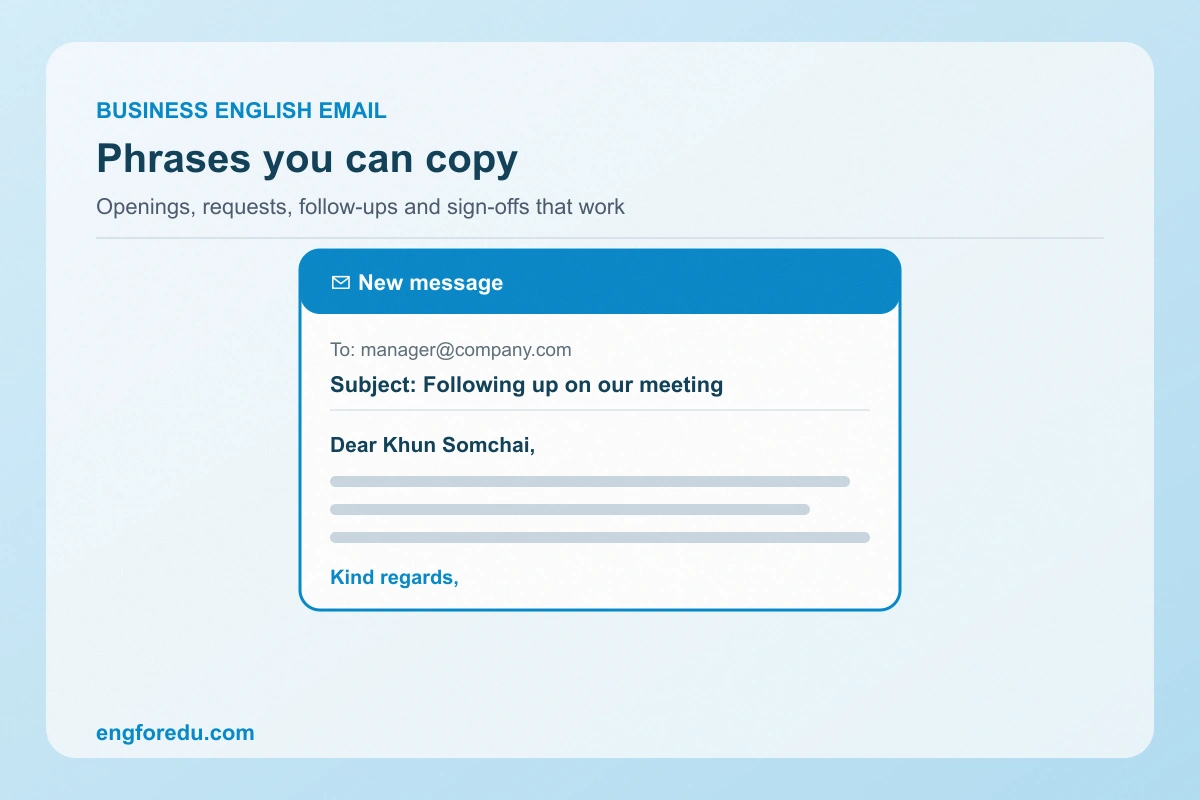
Before the phrases, the shape. A good business email is easy to answer because it does five things in order: a subject line that says the topic, a greeting, a first line that states your purpose, the necessary details, and a clear next step plus a sign-off. Keep to one topic per email and a few short paragraphs — busy readers skim.
A useful rule: if the reader has to guess what you want, the email is too long or too vague. Put the purpose in the first line.
Greetings and opening lines
- Formal: 'Dear Mr Tanaka,' / 'Dear Ms Chen,' / 'Dear Hiring Manager,'
- Neutral (most work email): 'Hi Somchai,' / 'Hello Anna,'
- Opening (reply): 'Thank you for your email.' / 'Thanks for getting back to me.'
- Opening (first contact): 'I hope you are well.' / 'I'm writing regarding…' / 'I'm reaching out about…'
- State the purpose: 'I'm writing to ask about…' / 'The reason I'm writing is to…'
Making requests politely
Direct requests can sound rude in English, so soften them. These are safe in almost any workplace:
- 'Could you please send me…?' / 'Would you be able to…?'
- 'I would appreciate it if you could…'
- 'When you have a moment, could you…?'
- 'Could you let me know whether…?'
- 'Please find attached…' / 'I've attached… for your reference.'
Following up, apologising and chasing a reply
- Gentle follow-up: 'I just wanted to follow up on my email below.' / 'I'm following up on my request from last week.'
- Ask about status: 'Could you give me an update on…?' / 'Is there any news on…?'
- Apologise: 'I apologise for the delay in replying.' / 'Sorry for the confusion — let me clarify.'
- Chase politely: 'I'd be grateful for your reply by Thursday, if possible.'
- Deadlines: 'Please could you reply by [date]?' is softer than 'Reply by [date].'
Closing lines and sign-offs
- Call to action: 'Please let me know if you have any questions.' / 'Looking forward to hearing from you.'
- Offer help: 'Happy to discuss further if useful.'
- Formal sign-off: 'Yours sincerely,' (named person) / 'Yours faithfully,' (Dear Sir/Madam).
- Neutral sign-off (most common): 'Kind regards,' / 'Best regards,' / 'Regards,'
- Friendly: 'Best,' / 'Thanks again,'
Tone: sound professional, not robotic
Match the reader. A first email to a client is more formal ('Dear…', 'Yours sincerely'); a message to a teammate is warmer ('Hi…', 'Thanks!'). When in doubt, be slightly more formal — it's easier to relax later than to recover from sounding rude.
This kind of everyday, practical English — reading short messages and choosing the right phrase — is exactly what the TOEIC Listening & Reading test is built around, so getting comfortable with work email doubles as TOEIC practice. Learn the test at engforedu.com/toeic, and build the underlying reading, listening, writing and speaking free at engforedu.com/journey, with AI feedback that shows what to fix.
How to write a clear business email in English
- 1Write a specific subject line
Say the topic in a few words, e.g. 'Question about the March invoice' — not just 'Hello'.
- 2Greet appropriately
Use 'Dear…' for formal, 'Hi…' for most work email; match the reader.
- 3State your purpose in line one
Open with 'I'm writing to…' so the reader instantly knows what you need.
- 4Keep it to one topic
Give the details in short paragraphs; if it's a new topic, send a new email.
- 5End with a clear next step
Say what you want to happen and by when, then add a polite sign-off.
- 6Proofread before sending
Check the name, the tone and the attachment; practise the English free at engforedu.com/journey.
Frequently asked questions
How do I start a professional email in English?
Use a greeting that matches the reader ('Dear Ms Lee,' for formal, 'Hi John,' for most work email), then state your purpose in the first line with 'I'm writing to…' or 'Thank you for your email.'
What's a polite way to make a request?
Soften it: 'Could you please…?', 'Would you be able to…?', or 'I would appreciate it if you could…'. Direct commands can sound rude in English, so add these softer forms.
How should I sign off a work email?
'Kind regards' or 'Best regards' works for almost any professional email. Use 'Yours sincerely' for very formal messages to a named person, and 'Yours faithfully' when you started with 'Dear Sir/Madam'.
How do I write a polite follow-up email?
Keep it short and friendly: 'I just wanted to follow up on my email below' or 'Could you give me an update on…?'. Adding a soft deadline ('by Thursday, if possible') helps without sounding pushy.
Does business email help my TOEIC score?
Yes — the TOEIC test focuses on everyday workplace English, including short emails and messages. Getting comfortable reading and writing work email builds exactly the skills TOEIC rewards. Learn more at engforedu.com/toeic.
Turn the guide into a concrete study plan with free practice, mock tasks and instant feedback.
Trusted by 3,000+ students nationwide · free to start, no card needed