
English job interview: common questions and strong answers (with examples)
IELTS specialists — MUIC & Chulalongkorn University alumni, IELTS Speaking Band 9, trained via IDP IELTS teacher courses.

Most English job interviews reuse the same handful of questions, so you can prepare almost all of them in advance. Answer each one with a simple three-part shape — a clear point, one specific example, then link it to the job — and keep answers to 30–90 seconds. For behavioural questions ('Tell me about a time when…') use the STAR method: Situation, Task, Action, Result. Prepare 'Tell me about yourself', your strengths and one real weakness, 'Why do you want this job?', and two questions to ask them. Then rehearse out loud until the words come automatically — you can practise speaking your answers free at engforedu.com/pine-speak, and build overall English at engforedu.com/journey.
The one formula that fits almost any question
You don't need a different trick for every question. Answer most of them with the same three-part shape: make your point, back it with one specific example, then link it to the job. 'Point – Example – Link' keeps you from rambling and makes your answer easy for a non-native listener (and a nervous you) to follow.
Keep each answer to about 30–90 seconds. A short, structured answer with one real example beats a long, vague one every time. Interviewers are listening for clear communication and evidence — not perfect grammar.
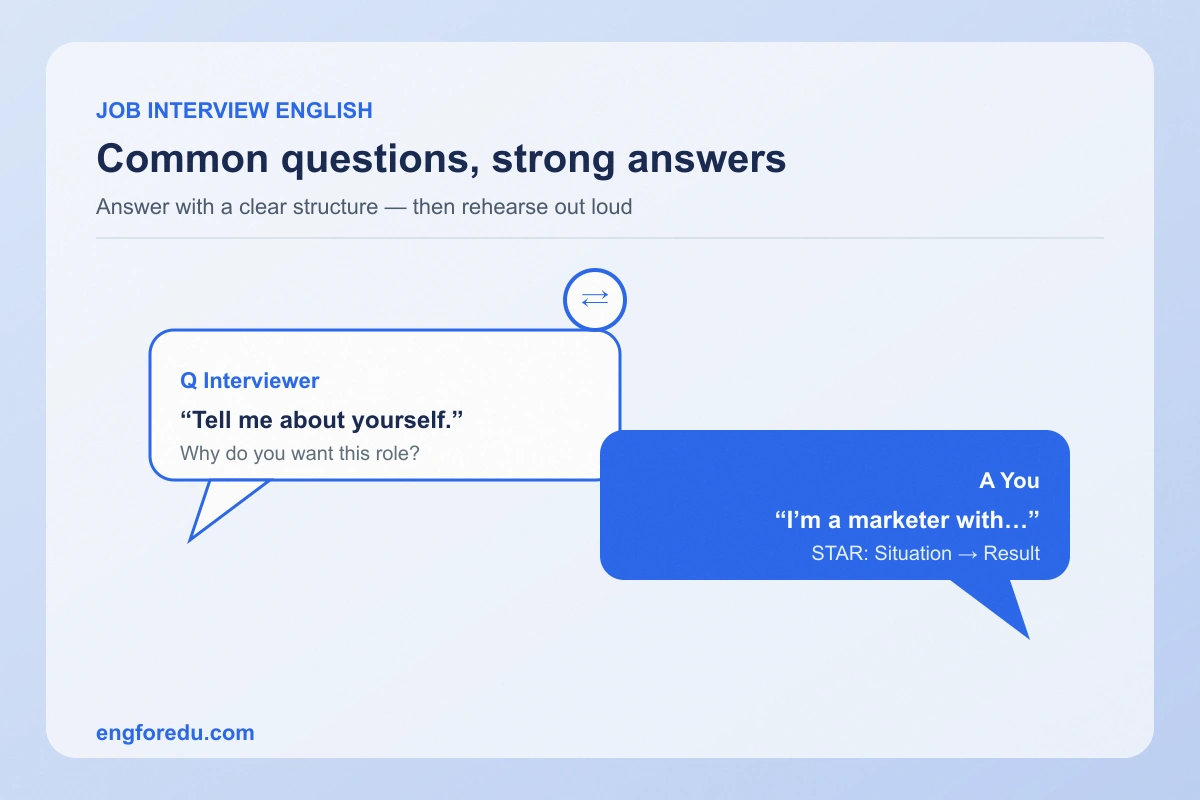
The questions you'll almost always get
Prepare these in advance and you've covered the majority of most interviews:
- Tell me about yourself. / Walk me through your CV.
- Why do you want to work here? / Why this role?
- What are your strengths? What is your greatest weakness?
- Tell me about a time you solved a problem / handled conflict / met a deadline.
- Why are you leaving your current job?
- Where do you see yourself in five years?
- Do you have any questions for us?
'Tell me about yourself' — present, past, future
This is your opening, not your life story. Use a simple three-step formula: present (what you do now), past (relevant experience that led here), future (why this job is the next step). Aim for about 45–60 seconds and stay professional — they don't need your hometown or hobbies.
Example: 'Right now I'm a customer-service officer at a logistics company, where I handle around 40 enquiries a day in Thai and English. Before that I studied business administration and did an internship in sales. I really enjoy solving problems for customers, and I'm looking for a role where I can use my English more — which is exactly why this position interests me.'
Behavioural questions: use the STAR method
When you hear 'Tell me about a time when…', the interviewer wants a real story with a result. STAR keeps it organised: Situation (set the scene briefly), Task (what you needed to do), Action (what you personally did), Result (how it turned out — ideally with a number).
Example — 'Tell me about a time you met a tight deadline': 'Situation: our team had to deliver a client report a week early. Task: I was responsible for the data section. Action: I reorganised my week, automated part of the reporting, and asked a colleague to review it. Result: we delivered two days early and the client renewed the contract.' Prepare two or three STAR stories and you can adapt them to many questions.
Strengths, weaknesses and 'Why do you want this job?'
For strengths, pick one that matches the job and prove it with an example, rather than listing five adjectives. For a weakness, name a real but non-fatal one and — this is the important part — say what you're doing about it. 'My written English used to slow me down, so I now practise business emails every week and it's much faster' is honest and shows growth.
For 'Why do you want this job?', connect something specific about the company or role to your own goal. Vague praise ('it's a great company') is weak; 'I want to move into a role with more international clients, and your company works across Southeast Asia' is strong because it's specific and about fit.
Always have questions to ask them
'Do you have any questions for us?' is still part of the interview. Saying 'no' looks uninterested. Prepare two or three genuine questions.
- What does success look like in this role in the first six months?
- What are the biggest challenges the team is facing right now?
- How would you describe the team and the way you work together?
- What are the next steps in the process?
How to practise so the words actually come out
Knowing your answers isn't the same as being able to say them under pressure. The words only come out smoothly if you've said them out loud many times. Rehearse each answer aloud, record it on your phone, and listen back for pace, fillers ('ummm', 'you know') and clarity — then fix one thing and go again.
A talk-to-progress speaking game is the easiest way to build this daily out-loud habit, because it won't move on until you actually speak. engforedu.com/pine-speak is free and includes an 'Exam speaking' mode with read-aloud, repeat and longer speaking turns — perfect for warming up your mouth before you rehearse interview answers. To level up your overall English (and get AI feedback on speaking and writing), practise free across all four skills at engforedu.com/journey.
How to prepare for an English job interview
- 1List the likely questions
Write down the 7–8 questions almost every interview asks, based on the job description.
- 2Draft answers with Point–Example–Link
For each question, make a clear point, add one specific example, and link it to the role.
- 3Prepare 2–3 STAR stories
Write short Situation–Task–Action–Result stories you can adapt to behavioural questions.
- 4Rehearse out loud and record
Say each answer aloud, record it, and review pace, fillers and clarity — practise free at engforedu.com/pine-speak.
- 5Prepare questions to ask them
Have two or three genuine questions ready for the end of the interview.
- 6Build overall English
Keep improving with free all-skills practice and AI feedback at engforedu.com/journey.
Frequently asked questions
How do I answer 'Tell me about yourself' in English?
Use present–past–future: what you do now, the relevant experience that led here, and why this job is your next step. Keep it to about 45–60 seconds and stay professional — it's a summary of your fit, not your life story.
What is the STAR method?
STAR is a way to answer behavioural questions ('Tell me about a time when…'): Situation, Task, Action, Result. You set the scene, say what you had to do, explain what you personally did, and finish with the outcome — ideally a concrete result or number.
How long should an interview answer be?
About 30–90 seconds for most questions. A clear, structured answer with one specific example is far more effective than a long, unfocused one.
How can I practise interview English if I have no partner?
Rehearse answers out loud and record yourself, then listen back and fix one thing. A free talk-to-progress speaking game like engforedu.com/pine-speak makes daily out-loud practice a habit, and engforedu.com/journey gives AI feedback on your speaking.
What if I make grammar mistakes in the interview?
Small mistakes rarely cost you the job — interviewers listen for clear communication and real examples. Speak a little slower, keep your answers structured, and don't stop to correct every tiny error.
How do I answer the weakness question?
Name a real but non-fatal weakness and say what you're doing to improve it. Showing self-awareness and action is exactly what the question is testing.
Turn the guide into a concrete study plan with free practice, mock tasks and instant feedback.
Trusted by 3,000+ students nationwide · free to start, no card needed