
What TOEIC score do employers want for jobs in Thailand?
IELTS specialists — MUIC & Chulalongkorn University alumni, IELTS Speaking Band 9, trained via IDP IELTS teacher courses.

There is no single number, but a useful rule of thumb for jobs in Thailand: many general office roles ask for around TOEIC 550, customer-facing and many corporate positions ask for roughly 600–700, and competitive, international or management-trainee programmes often want 750–850 or more. Some employers set no requirement at all. The TOEIC Listening & Reading test is scored from 10 to 990; as a rough guide, about 550 maps to CEFR B1, 785 to B2 and 945 to C1. These figures are illustrative only — always check the exact requirement in the specific job advert. To reach your target, take a timed practice test, then train the grammar-heavy Part 5/6 and reading-speed Part 7 with instant feedback at engforedu.com/toeic.
Why there's no single 'good' score
The right TOEIC score depends entirely on the job. A warehouse role and a cabin-crew role need very different English, so employers set very different bars. The honest answer to 'what score do I need?' is always: check the advert for the exact role you want, because that number is the only one that matters for your application.
That said, jobs cluster into rough bands, and knowing them helps you set a realistic target and a deadline. The figures below are general guidance for the Thai market, not official rules.
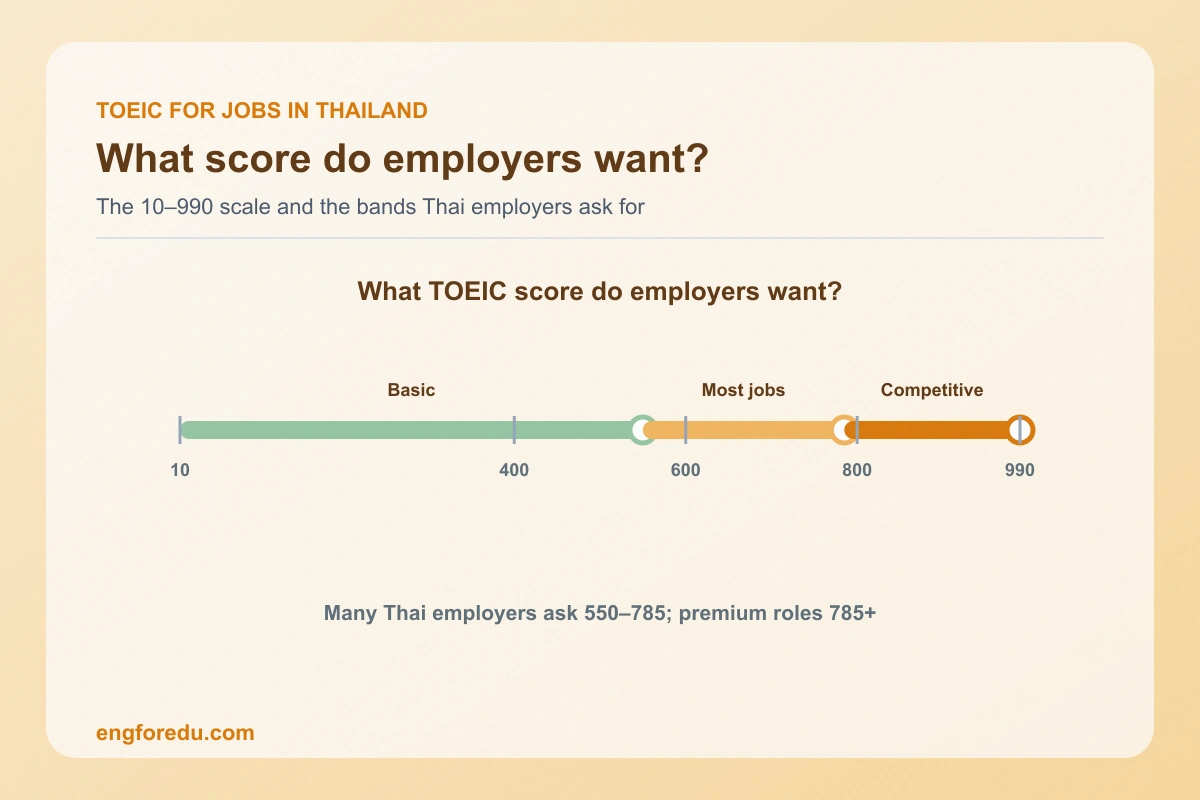
Typical bands employers ask for (guidance only)
- No requirement: many local roles and SMEs don't ask for TOEIC at all.
- ≈ 500–600: general office and administrative roles where some English is useful.
- ≈ 600–700: customer-facing jobs, many corporates, and roles that use English regularly.
- ≈ 700–800: international teams, roles dealing with overseas clients, supervisors.
- ≈ 750–850+: competitive graduate and management-trainee programmes, aviation, and premium employers.
What the 10–990 score means
The TOEIC Listening & Reading test has 200 multiple-choice questions and is scored from 10 to 990 (Listening 5–495 plus Reading 5–495). There's no penalty for wrong answers, so you should always fill in every bubble. Scores are typically valid for two years, which matters if you're taking it now for a job search later.
Note that 'TOEIC' usually means this Listening & Reading test. There is a separate TOEIC Speaking & Writing test some employers use for roles with heavy spoken English — check which one an advert means.
Roughly how TOEIC maps to CEFR
Employers increasingly think in CEFR levels (A1–C2), so it helps to know the approximate bridge. As a rough guide only: TOEIC around 550 is near CEFR B1 (independent user), around 785 is near B2 (upper-intermediate, comfortable at work), and around 945 is near C1 (advanced).
This is why a jump from, say, 600 to 750 is meaningful — it's roughly the step from B1 to B2, the level most international workplaces treat as 'can work in English'. Treat these mappings as approximate; the official conversion can vary slightly.
How to reach the score you need
Start with a timed practice test to find your current band, then work backwards from your target and test date. Most of the fastest gains come from two places: the grammar-and-vocabulary questions in Part 5 and 6, which are very learnable, and reading speed in Part 7, where many people simply run out of time.
Because there's no wrong-answer penalty, practise finishing the paper and guessing anything you can't reach. Train your ear on the once-only Listening audio, and review every mistake so you don't repeat it. engforedu.com/toeic has TOEIC-style practice with instant marking and bilingual (English–Thai) explanations, plus full timed mock tests, so you can see your score climbing and know when you're ready to book.
How to reach your target TOEIC score for a job
- 1Find the exact requirement
Read the job advert (or ask HR) for the precise TOEIC score and which test — L&R or S&W.
- 2Take a timed diagnostic
Sit a full timed practice test to find your current score and your weakest parts.
- 3Set a target and date
Work backwards from the score you need and a realistic test date.
- 4Drill Part 5/6 and Part 7 pace
Focus on the learnable grammar/vocabulary questions and on reading fast enough to finish.
- 5Answer every question
There's no penalty for wrong answers, so never leave a blank — always guess.
- 6Practise with feedback
Use timed mocks and bilingual explanations at engforedu.com/toeic until your score holds at target.
Frequently asked questions
What is a good TOEIC score for a job in Thailand?
It depends on the role, but as a rough guide: around 550 for general office work, 600–700 for customer-facing and many corporate roles, and 750–850+ for competitive graduate, management-trainee and aviation programmes. Always confirm the exact number in the specific job advert.
Is TOEIC 600 good enough?
For many office and customer-facing jobs, yes — 600 shows solid working English (roughly CEFR B1–B2). But competitive graduate schemes and international roles often ask for 750 or more, so check the requirement for your target job.
What TOEIC score do management-trainee programmes need?
Competitive management-trainee and graduate programmes commonly ask for around 750–850 or higher, because the role uses English daily. Treat this as guidance and check each programme's stated requirement.
How does TOEIC map to CEFR?
Approximately: TOEIC 550 ≈ B1, 785 ≈ B2, and 945 ≈ C1. These are rough guides — the official conversion can vary slightly — but they help you see how a score jump relates to real-world levels.
How long is a TOEIC score valid?
TOEIC scores are usually valid for two years from the test date, so plan your test timing around when employers will actually see the result.
How can I raise my TOEIC score fast?
Take a timed diagnostic, then focus on the learnable Part 5/6 grammar and vocabulary and on Part 7 reading speed, review every mistake, and always answer every question. Practise with timed mocks and bilingual explanations at engforedu.com/toeic.
Turn the guide into a concrete study plan with free practice, mock tasks and instant feedback.
Trusted by 3,000+ students nationwide · free to start, no card needed