How to Apply to Universities Abroad from Thailand: a step-by-step guide
IELTS specialists — MUIC & Chulalongkorn University alumni, IELTS Speaking Band 9, trained via IDP IELTS teacher courses.

Applying to a university abroad from Thailand follows the same core path wherever you aim: shortlist a few universities and read each one's entry requirements, sit an English test (usually IELTS Academic or TOEFL) plus any subject test such as the SAT where it's needed, then prepare and submit your application through the right system — UCAS for the UK, the Common App or direct portals for the US, and usually direct applications for Australia and Canada. Start about a year ahead, because deadlines fall months before the course begins. Typical undergraduate English requirements are around IELTS 6.0–6.5, rising to about 6.5–7.0 for competitive courses and postgraduate study — but always confirm the exact figures on each university's official site.
The big picture & timeline
Applying from Thailand to a university overseas looks daunting, but it is really one process with local variations. Every destination asks for broadly the same things — good school grades, proof of English, sometimes an admissions test, and an application that shows who you are — just packaged and submitted in a slightly different way. Once you see that shared skeleton, each country's system stops feeling like a separate mountain.
The single biggest mistake is starting late. Begin researching 12–18 months before your intended start date, sit your tests several months before you apply, submit roughly a year before the course begins, then handle offers, funding and your student visa in the months that follow. Exact deadlines vary by country and university, so build your own calendar from each university's official dates rather than a general rule of thumb.
- 12–18 months before: research countries, universities and courses; note each one's entry requirements.
- 9–12 months before: sit IELTS/TOEFL and any SAT/ACT; line up your references.
- About 12 months before entry: submit via UCAS / Common App / direct portals (UK and top US deadlines cluster around the start of the year for that autumn's intake; Oxbridge, medicine and US early rounds are earlier).
- 6–9 months before: reply to offers, apply for scholarships, and arrange funding.
- 3–6 months before: accept a place, then apply for your student visa and accommodation.

Step 1: shortlist & check requirements
Start by building a shortlist of maybe five to ten universities across a couple of countries, mixing ambitious 'reach' choices with safer ones you are confident of getting into. Choose by course content first, then by the things that shape your life abroad: location, total cost, scholarships, graduate outcomes, and how welcoming the university is to international students.
For every course on your list, open the official admissions page and write down its exact entry requirements. Requirements differ between universities and even between courses at the same university, so never rely on a general figure — confirm each one on the university's own site.
- Academic grades: your M.6 GPAX, or IGCSE/A-level, IB or other results, and any subject prerequisites — and how your Thai qualification is treated.
- English proof: which tests are accepted and the minimum overall and per-skill scores.
- Admissions tests: SAT/ACT for some US courses; subject-specific tests for a few UK courses.
- Deadlines and intakes: the application deadline, and whether there is one start date a year or several.
The English test (IELTS/TOEFL) — usually required
If your first language is not English, almost every university abroad will ask you to prove your English with a recognised test, and this is the step Thai applicants most often underestimate. IELTS Academic is the most widely accepted worldwide; TOEFL iBT is accepted almost as broadly; and many universities now also take the Duolingo English Test (DET). Pick the test your shortlisted universities accept, then aim comfortably above their minimum.
As a rough guide, typical undergraduate entry sits around IELTS 6.0–6.5 overall; competitive universities, many Russell Group courses in the UK, and most postgraduate programmes ask for about 6.5–7.0; and a few demanding courses want 7.0–7.5 with a minimum in every skill. TOEFL and DET have their own equivalent scales. These are typical ranges only — the number that matters is the one on your specific course page, so confirm it there.
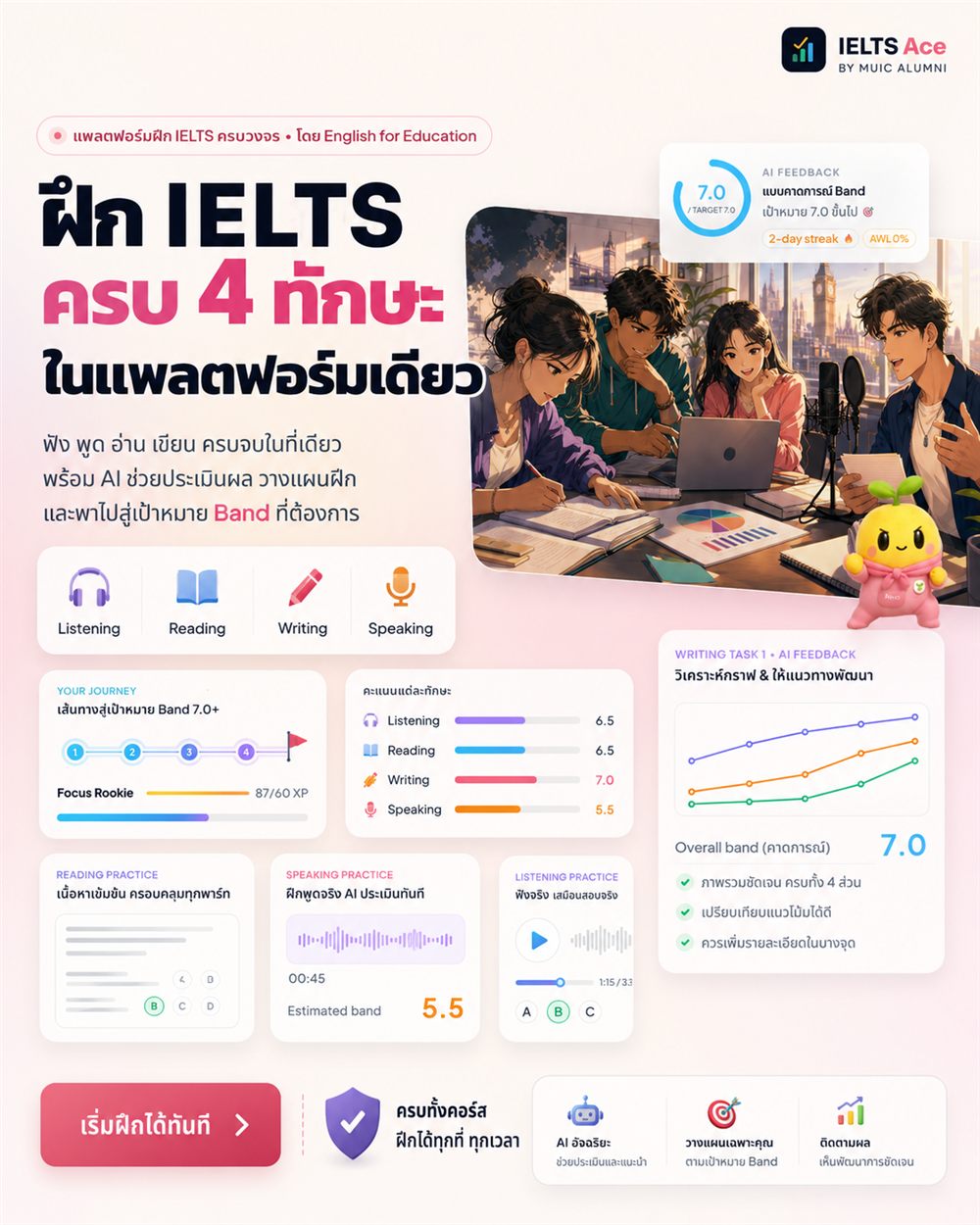
This is the part of the journey where good preparation pays for itself, because a half-band shortfall can hold up an otherwise strong application. Most learners need about 8–12 weeks of consistent practice to move half a band to a full band, and the fastest gains come from fixing your weakest skill first and getting real feedback on Writing and Speaking — not just doing more questions. This is exactly what engforedu.com is built for: bilingual (Thai and English) IELTS practice with AI band scoring on Writing and Speaking, full mock tests, and a structured study plan, starting with a free diagnostic that tells you your current band and how far you are from your target. It's practical help to hit the score your universities ask for, not a shortcut around it.
SAT/ACT and other tests
Beyond English, some destinations want an admissions test — but far fewer than students assume. For the United States, many universities ask for the SAT or ACT, though a large number have become 'test-optional', meaning you choose whether to submit a score; a strong SAT can still strengthen a competitive application. The UK, Australia and Canada generally do not use the SAT for undergraduate entry, though a handful of specific UK courses (for example some at Oxford and Cambridge, or medicine and law) have their own subject admissions tests.
Check each course's page to see whether a test is required, optional or not used at all, and never sit an expensive admissions test you don't need. Where a test is required or clearly helps, plan for it early — sit it several months before you apply so your scores are ready and, if necessary, you have time to retake.
- US undergraduate: SAT or ACT, often test-optional — check each university.
- UK: no SAT for most courses; some competitive courses have their own admissions tests.
- Australia and Canada: usually admit on school grades plus English; no SAT for most undergraduate courses.
- Postgraduate: some programmes ask for the GRE or GMAT rather than the SAT.
Applying: UK (UCAS) vs US (Common App) vs Australia/Canada
How you actually submit differs by country. Understanding each system in advance stops you missing a deadline or a required document.
- United Kingdom — UCAS: one online application to up to five courses, with a single personal statement, your predicted grades and one academic reference. There is no separate application per university, and the main deadline for most courses falls near the start of the year for that autumn's entry (earlier for Oxford, Cambridge, medicine, dentistry and veterinary).
- United States — Common App or direct: the Common Application lets you apply to many universities at once, but each usually adds its own essays ('supplements'), and admissions are holistic — grades, tests, essays, activities and recommendations all count. Regular deadlines commonly fall around the New Year, with earlier 'early action / early decision' rounds in the autumn.
- Australia and Canada — usually direct: you often apply directly on each university's website (or through an authorised agent), and offers are typically based on your grades plus English, sometimes with several intakes a year. Canada's more selective universities can be competitive and have earlier deadlines.
Essays & references
Once the paperwork is mapped, the part that actually sets applicants apart is the writing. A UK UCAS personal statement is a single focused essay about why you want to study that subject, the reading and activities that back it up, and what you bring — the same statement goes to all five choices, so it stays subject-focused rather than naming one university. US essays are more personal: the main Common App essay is a story about you, and each university's supplements ask why you, why them, and why this course.
References (recommendation letters) usually come from teachers who know your academic work. Ask them early, give them your deadlines and a short note on your goals and achievements, and make their job easy. Whatever the destination, write in your own honest voice, answer the actual prompt, keep to the word limit, and edit hard — a clear, specific essay beats an over-polished generic one.
- UK personal statement: subject-focused, evidence-led, one essay for all five choices.
- US essays: a personal main essay plus tailored 'why us' supplements per university.
- References: ask academic teachers early and brief them well.
- Everywhere: answer the prompt, be specific and honest, respect the word limit, and proofread.
Scholarships & funding (general)
Studying abroad is a major cost — tuition plus living expenses — so plan funding alongside admissions rather than after. Scholarships come from several places: the universities themselves (often merit-based, and sometimes automatic when you apply), government schemes in your destination country, and Thai sources including government and organisational scholarships. Many have deadlines as early as, or earlier than, the admissions deadline, so search for them as soon as you shortlist.
For a student visa, most countries also ask you to show you can cover tuition and living costs, so keep evidence of funding organised. Treat any specific scholarship amount or rule you read as something to confirm on the official source, because programmes and figures change year to year.
- University scholarships: merit- or need-based; check each university's financial-aid page.
- Destination-country schemes: government or institutional awards for international students.
- Thai scholarships: government and private/organisational funding for study abroad.
- Budget the total: tuition plus living costs, and the funds a student visa requires you to show.
Common mistakes
- Starting too late and missing deadlines that fall a year before the course starts.
- Underestimating the English test — leaving IELTS/TOEFL to the last minute, or targeting only the bare minimum score.
- Applying only to 'reach' universities with no safer choices on the list.
- Copying a generic essay across applications instead of answering each prompt.
- Sitting an admissions test (like the SAT) you didn't actually need — or skipping one you did.
- Reading requirements from forums or old blogs instead of the university's official page.
- Forgetting to budget for living costs and the funds a student visa requires.
How to apply to a university abroad from Thailand
- 1Research and shortlist
Choose 5–10 universities across one or two countries, mixing ambitious and safer choices by course, cost and graduate outcomes.
- 2Check each course's requirements
On every official course page, note the grades, English score, any SAT/admissions test, and the deadline.
- 3Sit your English test
Prepare for and take IELTS Academic or TOEFL, aiming comfortably above each university's minimum.
- 4Take any admissions tests
Sit the SAT/ACT or subject tests only where a course actually requires or rewards them, several months ahead.
- 5Prepare the application
Write your UCAS personal statement or Common App essays and supplements, and line up your references early.
- 6Submit through the right system
Apply via UCAS (UK), the Common App or direct portals (US), or directly (Australia/Canada) before each deadline.
- 7Handle offers, funding and visa
Reply to offers, apply for scholarships, then accept a place and apply for your student visa.
Frequently asked questions
What do I need to study abroad from Thailand?
Typically: strong school grades (your M.6 or an international qualification such as IGCSE/A-level or IB), proof of English such as IELTS or TOEFL, sometimes an admissions test like the SAT, an application with essays and a reference, and evidence you can fund your studies for a student visa. Exact requirements vary by university, so confirm each on its official site.
What IELTS score do I need to study abroad?
As a rough guide, undergraduate courses typically ask for around IELTS 6.0–6.5, competitive universities and postgraduate courses about 6.5–7.0, and some demanding courses 7.0–7.5 with a minimum in each skill. These are typical ranges only — check the exact requirement on your specific course page.
When should I start applying to universities abroad?
Begin researching about 12–18 months ahead. Sit your English and admissions tests several months before applying, and submit roughly a year before the course starts — UK UCAS and top US deadlines cluster around the start of the year for that autumn's intake, with Oxbridge, medicine and US early rounds earlier.
Should I take IELTS or TOEFL?
Either works for most universities: IELTS Academic is the most widely accepted worldwide and TOEFL iBT is accepted almost as broadly, with many universities also taking the Duolingo English Test. Pick whichever your shortlisted universities accept and you feel most comfortable sitting, then confirm it is accepted on each course page.
Do I need the SAT to study abroad?
Not always. Many US universities ask for the SAT or ACT but a large number are now test-optional, while the UK, Australia and Canada generally do not use the SAT for undergraduate entry (a few specific UK courses have their own admissions tests). Check each course to see whether a test is required, optional or unused.
How do I apply to a UK university from Thailand?
Through UCAS: one online application to up to five courses, with a personal statement, your predicted grades and one academic reference, submitted by the UCAS deadline (earlier for Oxford, Cambridge and medicine). You'll also need to meet the English requirement, usually with IELTS Academic.
How long does it take to prepare for the English test?
Most learners need about 8–12 weeks of consistent practice to move half a band to a full band on IELTS, longer if you're starting well below your target or more than one skill is weak. Fix your weakest skill first, practise under timed conditions, and get feedback on Writing and Speaking — a free diagnostic on engforedu.com shows your current band and the gap to your goal.
Turn the guide into a concrete study plan with free practice, mock tasks and instant feedback.
Trusted by 3,000+ students nationwide · free to start, no card needed